
How to Invalidate a Trade Before You Enter
Most traders focus on where to enter and exit a trade, but professionals focus first on where the idea fails. This article explains how defining invalidation before entry improves discipline, reduces emotional decision-making, and protects capital.

Most traders spend the majority of their time deciding where to enter a trade and how much profit they hope to make. Professional traders approach the same decision from a different angle by first determining where the trade idea becomes invalid if price behaves differently than expected.
This shift in focus changes the entire decision-making process. Invalidation is not pessimism. It is clarity. By defining where an idea no longer makes sense, traders replace hope with structure before capital is exposed.
Trade invalidation is about logic, not pain tolerance. It asks a simple question: what specific price behavior would prove that the original premise behind this trade is wrong. Until that question is answered clearly, the trade remains incomplete, regardless of how attractive the setup appears.
Many traders confuse invalidation with stop placement, but the two are not the same. A stop is an execution tool, while invalidation is a conceptual boundary. Invalidation is defined by market structure, context, and assumptions, not by how much loss feels acceptable.
When invalidation is not defined in advance, traders often enter positions with flexible reasoning. As price moves against them, the rationale for the trade shifts. Levels are reinterpreted, targets are adjusted, and exits become emotional rather than deliberate. By the time the trade is closed, the original idea no longer exists.
Professional traders avoid this trap by treating invalidation as a prerequisite, not an afterthought. They identify the conditions under which the trade thesis fails and accept those conditions before entry. This allows decisions to be made calmly, without negotiation or internal conflict once the trade is live.
A useful mental model is to think of invalidation as the anchor of the trade. Entry and reward are variables, but invalidation defines whether the idea deserves capital at all. If invalidation cannot be expressed clearly in market terms, the trade is not yet ready.
The real-world benefits of this approach compound over time. Trades that fail are exited cleanly. Drawdowns remain contained. Confidence is preserved because losses occur within a predefined framework rather than through reactive decisions.
Invalidation also improves selectivity. Many trades that look attractive at first glance fail the invalidation test when examined more closely. This naturally reduces overtrading and shifts focus toward higher-quality opportunities where risk is well understood.
ChartDetector.ai reinforces this professional discipline by emphasizing trade validation over signal triggering. Trade ideas are evaluated within broader market context, helping traders identify when conditions undermine the original premise rather than encouraging blind persistence.
Before the next trade is entered, the most important question is not where price might go if everything works, but what must not happen for the idea to remain valid. When that answer is clear, execution becomes simpler and discipline becomes sustainable.
Related Articles

Why Markets Punish Consensus
When everyone agrees on where the market is going, the opportunity is often already diminishing. This article explains why consensus creates comfort but rarely creates edge, and why professional traders pay close attention to crowd positioning.
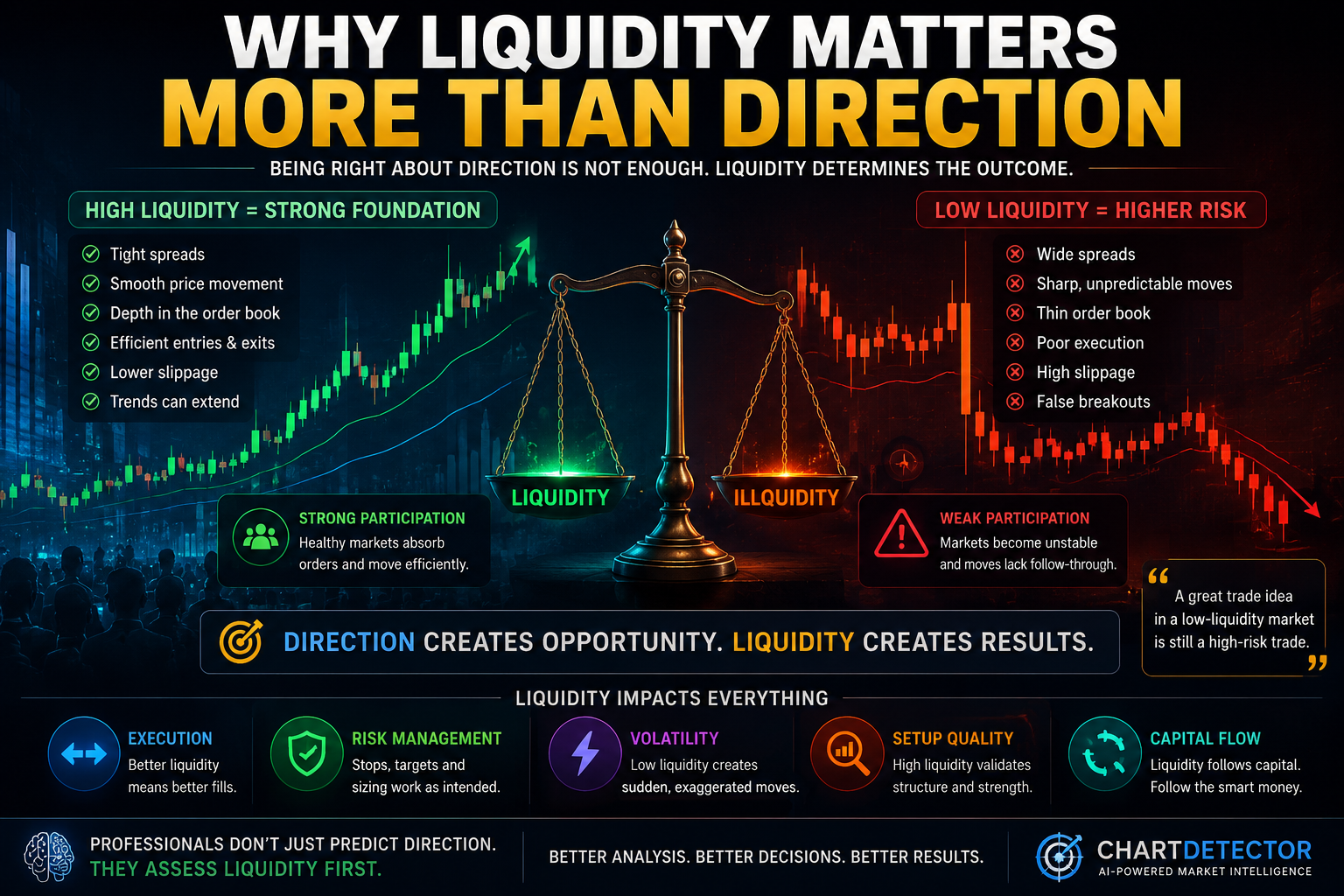
Why Liquidity Matters More Than Direction
Most traders focus on whether a market will move higher or lower. Professional traders focus on liquidity. This article explains why liquidity drives price movement, how it influences risk, and why being right about direction is often not enough.

Why Strong Trends Often Reverse When Participation Peaks
Strong trends often appear safest near their peak, yet this is frequently where reversal risk begins increasing. This article explains how participation saturation develops and why late-stage momentum can weaken market structure.