Why Traders Overestimate Prediction And Underestimate Process
Many traders focus on predicting market direction while neglecting the quality of their decision-making process. This article explains why prediction is overrated, how process drives consistency, and why professionals prioritize repeatable execution over being right.
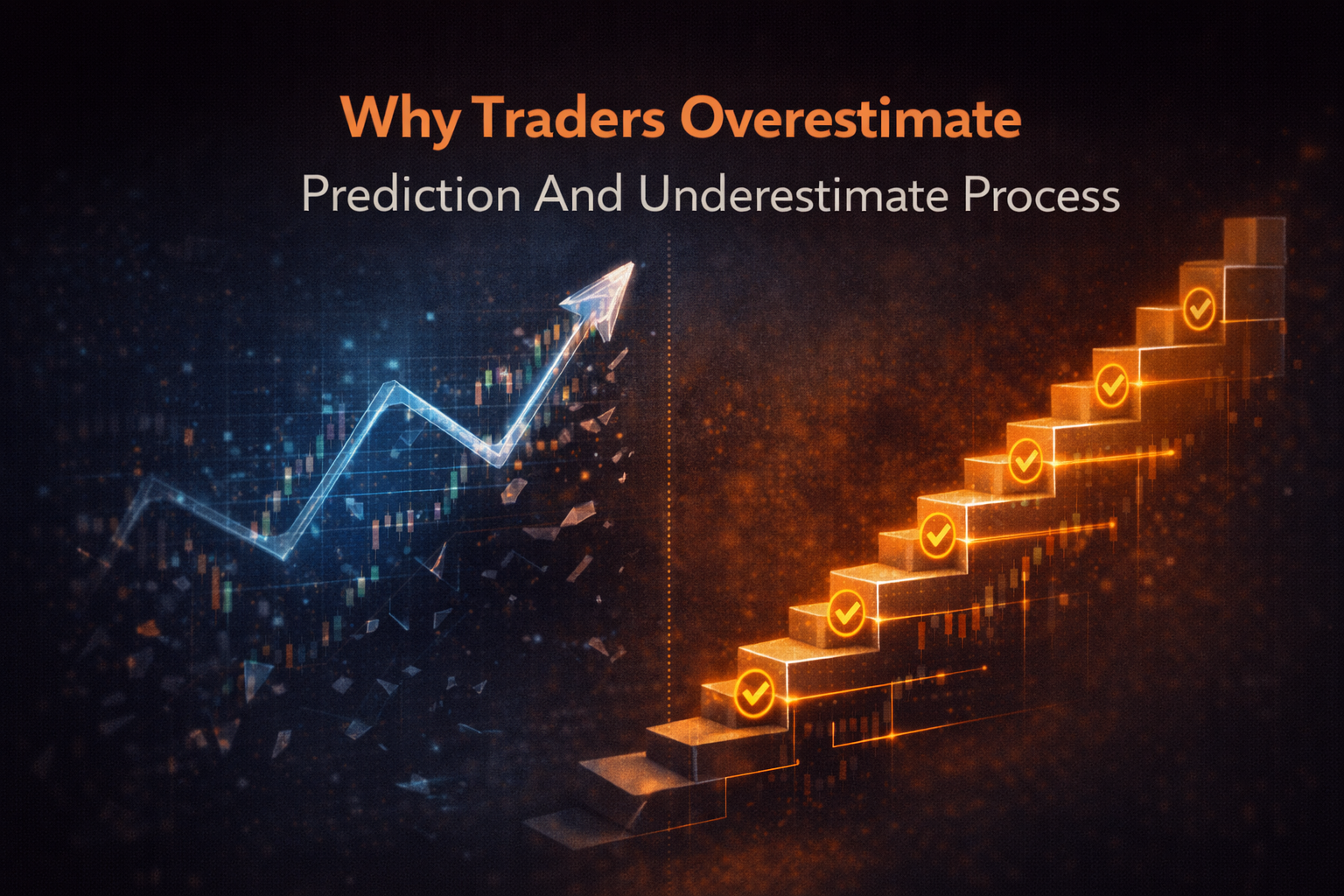
Many traders believe success comes from predicting where the market will go next. They focus on forecasts, targets, and scenarios, assuming that being right about direction is the primary determinant of profitability. Professional traders arrive at a different conclusion through experience: prediction is unreliable, while process is controllable.
Markets are complex systems influenced by countless variables, many of which cannot be observed or quantified in real time. Even well-reasoned predictions can fail due to changes in liquidity, sentiment, or external events. Expecting consistent accuracy in prediction places pressure on a skill that markets are designed to undermine.
Despite this, prediction remains attractive because it offers psychological closure. A forecast provides a narrative that feels decisive, even when it is fragile. Process, by contrast, feels slower and less exciting because it emphasizes preparation, evaluation, and restraint rather than certainty.
Professional traders accept uncertainty as a constant. Instead of attempting to eliminate it through prediction, they build processes that function regardless of outcome. A sound process defines risk, sets expectations, and governs behavior whether a trade wins or loses.
When traders overestimate prediction, several problems emerge. They become attached to being right, defend forecasts when evidence changes, and hesitate to exit positions that contradict their original view. Losses in these situations are often prolonged because abandoning a prediction feels like failure.
Underestimating process creates a different issue. Without a consistent framework, results become dependent on mood, recent outcomes, or market noise. Even correct predictions produce inconsistent results when execution varies from trade to trade.
A useful mental distinction is to separate outcome from decision quality. A good decision can produce a loss, and a poor decision can produce a win. Professionals judge themselves on whether decisions followed process, not on whether predictions were accurate.
Process also enables learning. When decisions are repeatable, outcomes provide meaningful feedback. Patterns emerge, mistakes become visible, and improvement becomes possible. Prediction-focused trading obscures this feedback because outcomes are attributed to correctness rather than execution.
AI reinforces this professional shift when used properly. By consistently evaluating conditions, highlighting risk, and reducing cognitive bias, AI supports process adherence rather than prediction. It does not make traders better forecasters, but it helps them become better decision-makers.
ChartDetector.ai is designed around this philosophy by emphasizing context, validation, and risk awareness over directional forecasts. The platform supports disciplined workflows that remain effective even when predictions fail.
Markets do not reward traders for being right. They reward traders for managing risk and executing well under uncertainty. The next time you feel compelled to predict what comes next, consider whether refining your process would offer a more reliable edge.
Related Articles

Why Markets Punish Consensus
When everyone agrees on where the market is going, the opportunity is often already diminishing. This article explains why consensus creates comfort but rarely creates edge, and why professional traders pay close attention to crowd positioning.
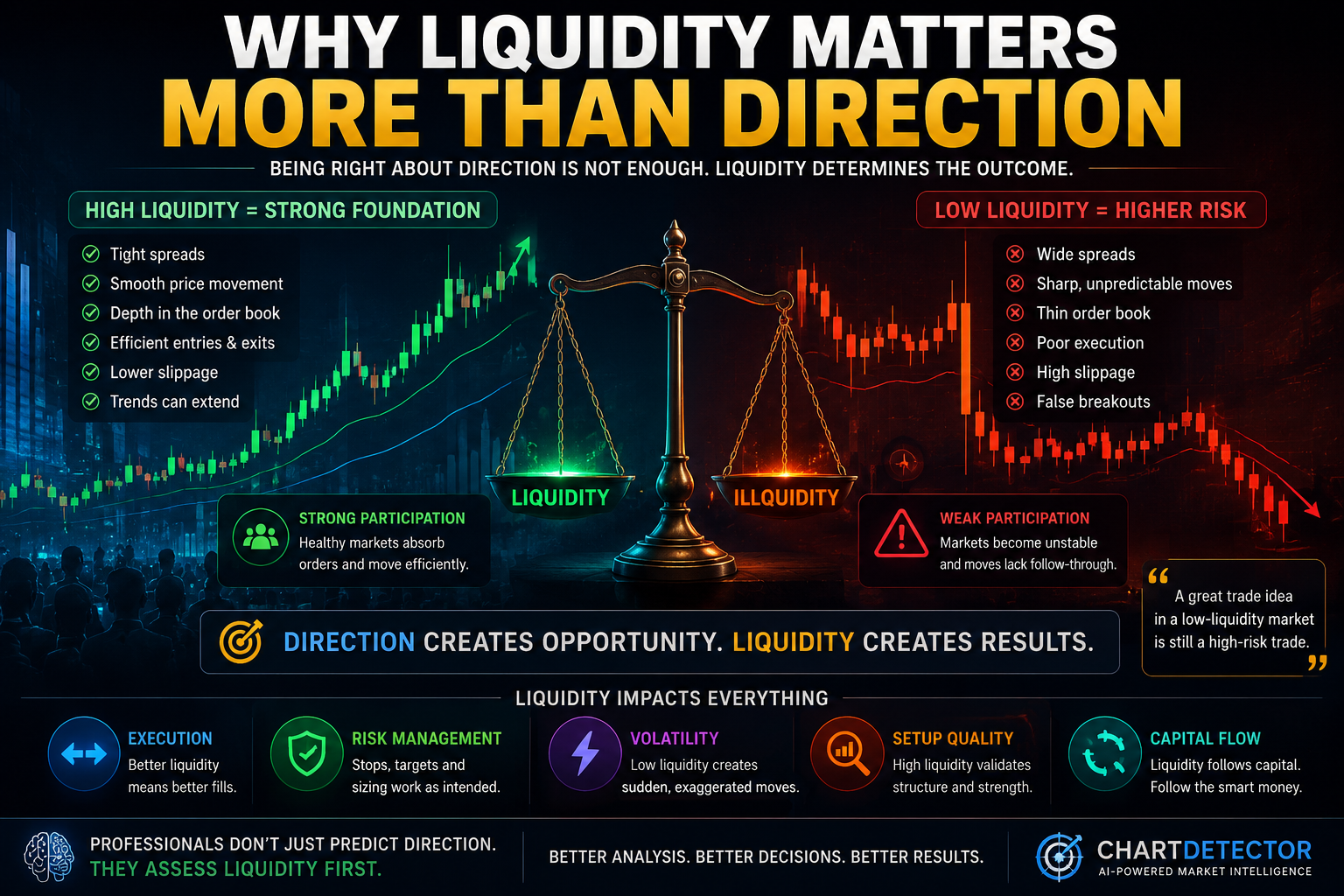
Why Liquidity Matters More Than Direction
Most traders focus on whether a market will move higher or lower. Professional traders focus on liquidity. This article explains why liquidity drives price movement, how it influences risk, and why being right about direction is often not enough.
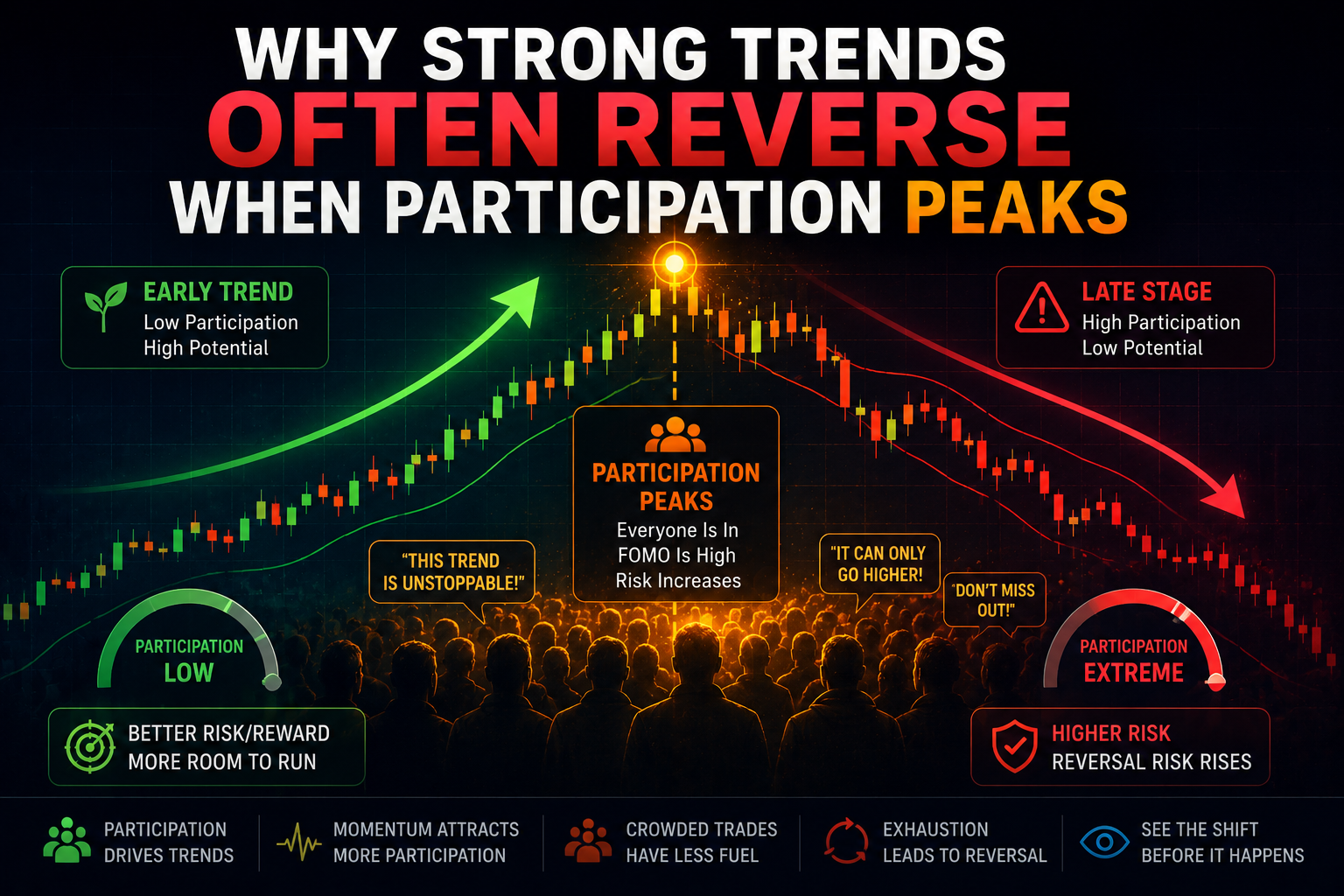
Why Strong Trends Often Reverse When Participation Peaks
Strong trends often appear safest near their peak, yet this is frequently where reversal risk begins increasing. This article explains how participation saturation develops and why late-stage momentum can weaken market structure.